A detective is a sworn police officer paid by the public to solve crimes. A private investigator is a licensed civilian paid by a client to find facts. In New York the detective works for a department like the NYPD and can arrest, search with a warrant and carry a shield. The PI holds a NYS Department of State license, cannot carry a badge of any kind and has the same arrest power as any other New Yorker.
- Who pays the public pays a detective, a client pays a PI
- Badge detectives carry one, General Business Law section 84 bans it for PIs
- Arrests a PI has only the citizen's arrest power in Criminal Procedure Law 140.30
- License PIs need age 25, 3 years of qualifying work, a $15 exam and a $10,000 bond
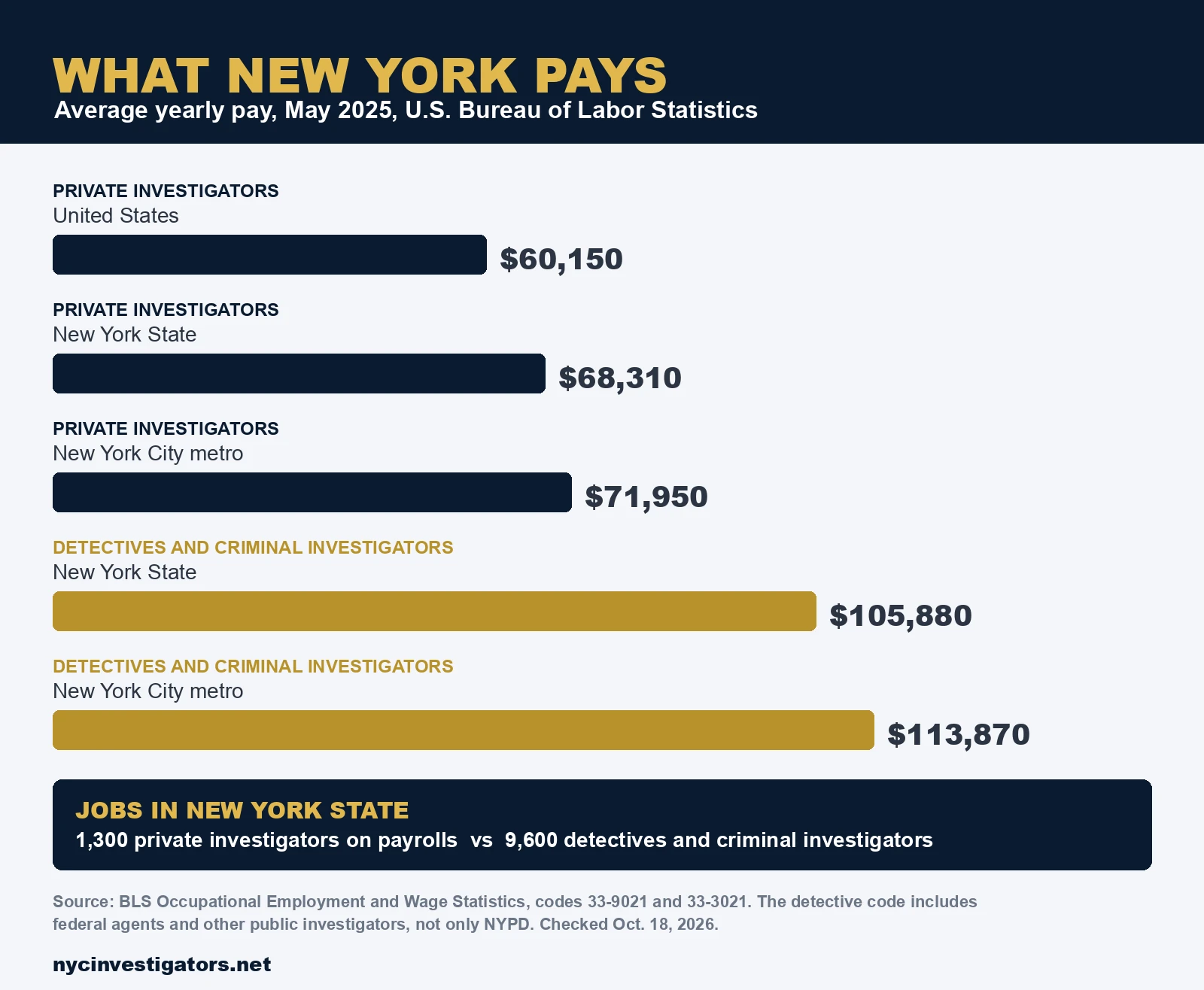
- Pay NYC metro average $71,950 for PIs and $113,870 for detectives and criminal investigators (BLS, May 2025)
We check New York investigator licenses for a living. Every profile in our directory starts with a state license check. And the mix-up we see most is simple. People call a PI a detective, or they expect a PI to do what only the police can do.
Most of what you find on this question is college blogs written for the whole country. None of them tell you the New York rules. So we laid them out, with the law, the license and the pay, as of October 2026.
Two Jobs That Share a Word
Both jobs dig for facts. That is where the overlap ends.
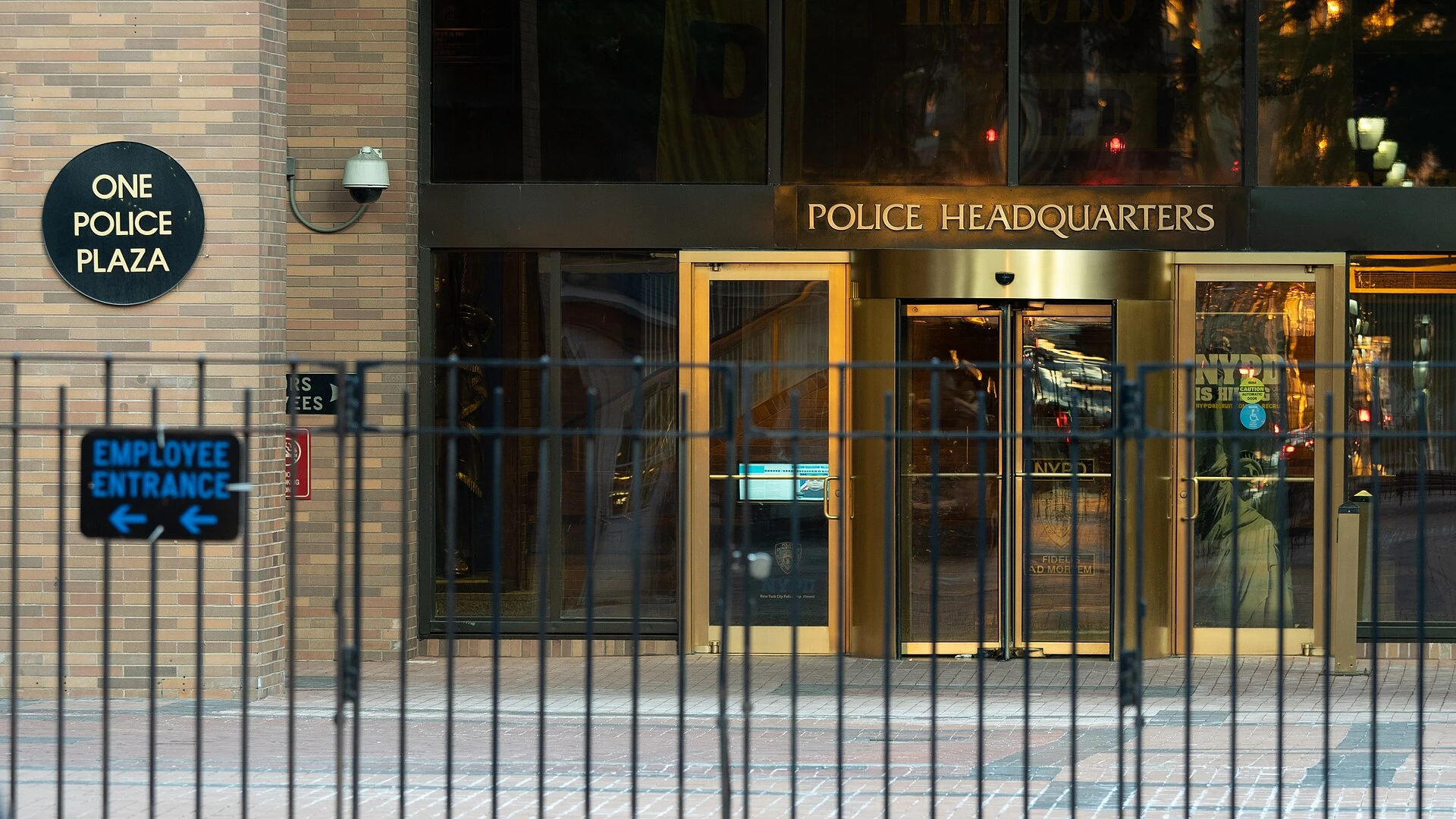
A detective works for the government. In New York City that means the NYPD Detective Bureau, which the department says handles the prevention, detection and investigation of crime. Its units run from precinct detective squads to homicide, special victims, cold case, missing persons and computer crimes. A detective's case belongs to the public. The goal is an arrest and a prosecution.
A private investigator works for whoever hires them. New York defines the job in General Business Law section 71 as gathering information for pay on a set list of matters. That list includes the credibility of witnesses, lost or stolen property, the cause of fires, accidents and injuries, employee honesty and evidence for use at trial. The PI's case belongs to the client. The goal is facts the client can use, often in a civil case or for a lawyer.
One more naming point. "Private detective" and "private investigator" mean the same job to most people. New York's law only uses "private investigator." A police detective is something else entirely.
Private Investigator vs Detective in New York, Side by Side
| Question | NYPD or other police detective | New York private investigator |
|---|---|---|
| Who pays them | The public, through the department | The client who hires them |
| Whose case it is | The state's. The district attorney decides on charges | The client's. The client decides what to do with the report |
| How they get the job | Hired as a police officer, then promoted or designated detective | State license from the NYS Department of State |
| Badge or shield | Yes | No. Banned by GBL section 84 |
| Arrest power | Full police arrest power | Only what any citizen has under CPL 140.30 |
| Search warrants and subpoenas | Can seek warrants through the courts | None of their own |
| Gun | Carried as part of the job | Only with a separate pistol license, and not in sensitive places |
| Cost to you | Nothing | Hourly or flat fee, set by the PI |
What a Detective Can Do That a PI Cannot
This matters when you are deciding who to call.
- Arrest. A detective has police arrest power. A PI does not. Under Criminal Procedure Law section 140.30, any person may arrest someone for a felony that person has in fact committed, or for a lesser offense committed in their presence. That is the citizen's arrest rule, and it is all a PI gets. A wrong guess can leave the PI and the client facing a lawsuit, so good investigators almost never use it.
- Warrants. Police can ask a court for a search warrant. A PI has no warrant power and no way to force anyone to talk or hand over records. Our guide on what a private investigator can legally do in New York covers the full line.
- The badge. General Business Law section 84 makes it unlawful for a licensed PI, or anyone working for one, to own, carry or show a badge or shield on the job. The same section bars any ad or statement that suggests the PI is an official police or investigative agency, or that would make someone think the PI is a police officer.
So if someone flashes a shield and says they are a private investigator, something is wrong. Either they are not a PI, or they are breaking the law that licenses them.
What a PI can do that a detective usually will not. Work only for you, on your timeline, on matters the police treat as civil. A theft the police logged and shelved, a fire your insurer disputes, a witness your lawyer needs to understand before trial. That is daily work for a New York PI.
How Each One Gets the Job in New York
The Detective Track
You do not apply to be a detective. The Bureau of Labor Statistics says detectives typically begin their careers as police officers, and that in large departments an officer may be promoted to detective. Most must first graduate from their agency's training academy.
New York State law has an 18 month rule. Under Civil Service Law section 58, an officer temporarily assigned to detective duties for more than 18 months must be made a permanent detective, in departments that do not give detective exams. The law carves out cities of one million people or more. In New York State, that means New York City, which runs its own system.
Inside the NYPD, investigators also take the department's Criminal Investigation Course, an intense 15 day course. It covers report writing, latent prints, subpoenas, search warrants, DNA evidence, crime scenes, interview and interrogation, and computer crimes.
The PI Track
The NYS Department of State licenses private investigators. As of October 18, 2026, its page lists these requirements.
- Age 25 or older.
- 3 years of qualifying experience, or 20 years as a police officer or fire marshal.
- A written exam passed within the two years before you apply. The exam fee is $15.
- A $10,000 surety bond.
- Fees of $400 for an individual license and $500 for a business. The license runs two years.
What counts as experience is set by General Business Law section 72. It names work as a sheriff, a city or county police officer, a state trooper, an investigator for a government agency, or an employee of a licensed PI. It also says plainly that work as a watchman, guard or private patrolman does not count.
So you do not need to be a cop to become a PI in New York. Three years working for a licensed investigator gets you there too. The full steps are in our guide on how to become a private investigator in New York.
What Each One Earns in New York
Here the gap is big. The figures below are average yearly pay from the BLS Occupational Employment and Wage Statistics for May 2025, the newest set as of October 2026. The figures cover code 33-9021 (private detectives and investigators) and code 33-3021 (detectives and criminal investigators).
| Area | Private investigators | Detectives and criminal investigators |
|---|---|---|
| United States | $60,150 average | Median $93,790 (BLS Outlook) |
| New York State | $68,310 average, 1,300 jobs | $105,880 average, 9,600 jobs |
| New York City metro | $71,950 average, 1,040 jobs | $113,870 average, 7,580 jobs |
Two cautions before you read too much into that. First, the detective code counts more than NYPD detectives. It also covers state and federal criminal investigators. Second, the PI count only covers people on a payroll. Self-employed investigators who run their own shops are not in those job counts, and many New York PIs work that way.
For a client, the useful number is different. Our guide on what a private investigator costs in NYC breaks down hourly rates and the costs that get added on.
Should You Call the Police or a PI?
Use this as a quick sort.
- A crime is happening, or someone is in danger. Call 911. A PI is never the first call.
- You are the victim of a crime. File a police report first. You will need it for insurance and court, and only the police can arrest and charge.
- The police took a report but the case went quiet. A PI can work for you or your lawyer to gather facts. They cannot take over the police case, and they should never get in its way.
- The matter is civil. An insurance dispute, a business loss, a lawsuit, a claim about a fire or an accident. Police usually do not handle these. This is PI work.
- You are charged with a crime. Your defense lawyer may hire a PI. Section 71 lists securing evidence for criminal trials as PI work.
Hiring? Ask for the license number and check it yourself. It takes two minutes with our guide on how to check a private investigator license in New York. A retired detective still needs that license to work as a PI. A long police career is not a license.
What We Hear Most
Is a private investigator the same as a detective?
No. A detective is a sworn police officer who works for a government agency. A private investigator is a licensed civilian hired by a private client. In New York the PI is licensed by the Department of State and has no police powers.
Can a private investigator arrest someone in New York?
Only the way any citizen can. Criminal Procedure Law section 140.30 lets any person arrest someone for a felony they actually committed, or for a lesser offense committed in their presence. PIs have no police arrest power.
Can I be a PI without being a cop?
Yes. New York accepts 3 years of work for a licensed private investigator or a government investigative agency. Police service is one route, not the only one. Guard and watchman work does not count.
Do PIs make a lot of money?
Less than police detectives on average. BLS data for May 2025 puts the average New York City metro PI at $71,950 a year, against $113,870 for detectives and criminal investigators.
Can a private investigator carry a badge in New York?
No. General Business Law section 84 bars licensed PIs and their employees from owning, carrying or showing a badge or shield while doing PI work.
Can a private investigator call himself a detective in New York?
General Business Law section 84 bars any ad or statement that suggests a PI is an official police or investigative agency, or that would make a person believe the PI is a police officer. Any title used in a way that does that is off limits.
Where These Numbers Come From
- NY General Business Law section 71, section 72 and section 84
- NY Criminal Procedure Law section 140.30
- NY Civil Service Law section 58
- NYS Department of State, Become a Private Investigator
- NYPD, Detective Bureau and Criminal Investigation Course
- BLS Occupational Outlook, Police and Detectives and Private Detectives and Investigators
- BLS Occupational Employment and Wage Statistics, May 2025
This guide is general information, not legal advice. Sources accessed October 2026. If you are in danger, call 911 first.