Yes, but not because of the PI license. A New York private investigator can carry a handgun only with a separate pistol license under Penal Law section 400.00, and even then the gun is banned in every "sensitive location" the state lists, from the subway to Times Square. Private investigators get no exemption from those bans as of October 2026.
- PI license gives zero gun rights
- Carry license separate, from the NYPD in the city or your county licensing officer elsewhere
- Training 16 hours in a classroom plus 2 hours of live fire
- Sensitive places 20 kinds, and carrying in one is a class E felony
- PI exemption bill S5718, still in committee

We check New York investigator licenses for a living. Every profile in our directory starts with a state license check. And one question comes up over and over, from clients and from new investigators: does the license let a PI carry a gun?
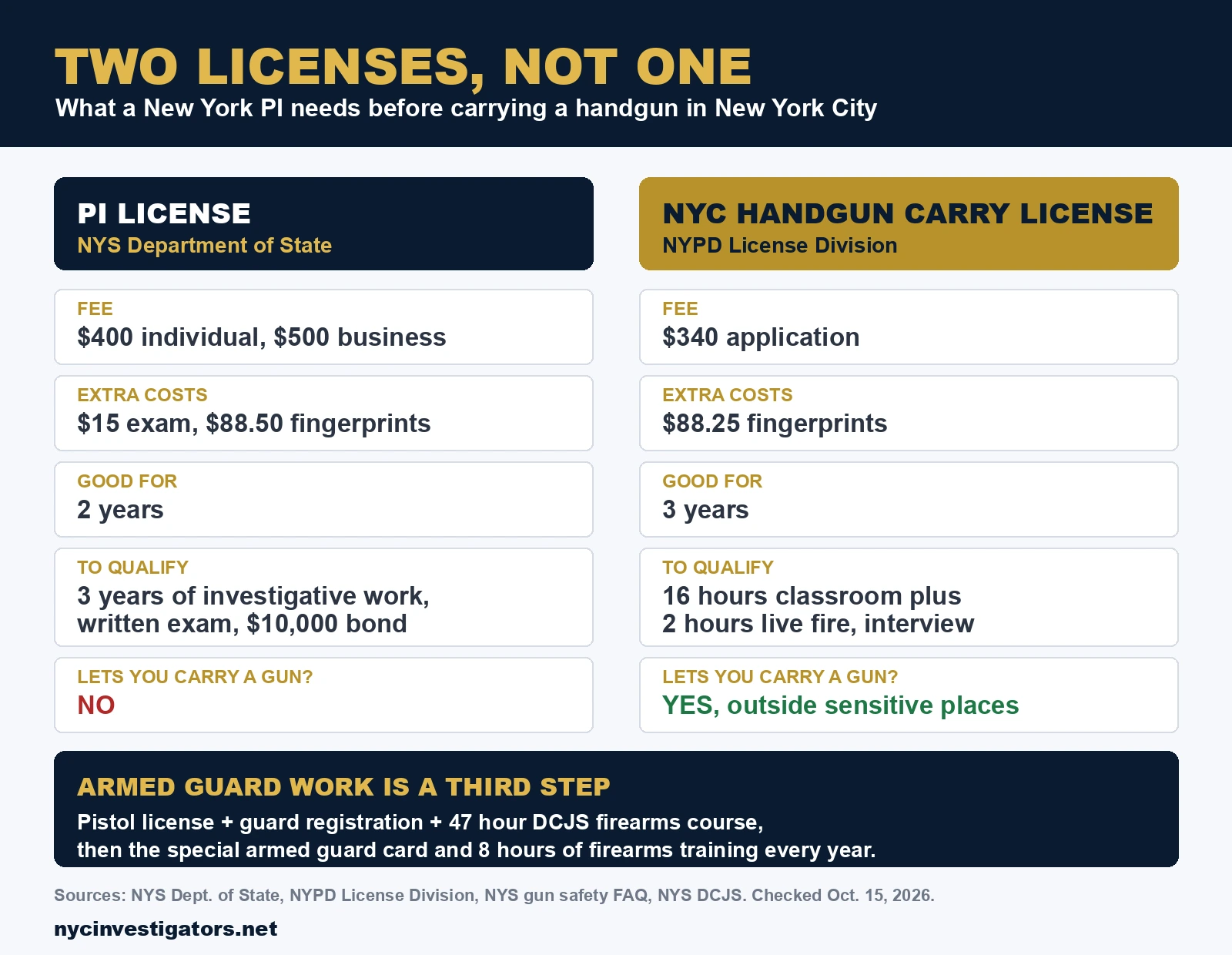
No. The license and the gun live in two different systems run by two different offices. The next sections cover how each one works, and where even a fully licensed, armed PI still cannot bring a gun.
The PI License Is Not a Gun License
New York licenses private investigators through the NYS Department of State. The license covers investigation work. It says nothing about weapons. The state's own private investigator page does not mention firearms at all.
Guns are a separate system. Under Penal Law section 400.00, anyone who wants to carry a handgun needs a pistol license from a local licensing officer. A PI applies the same way any other New Yorker does. There is no fast lane for investigators.
The PI law also takes something away. General Business Law section 84 bars licensed investigators and their staff from carrying or showing a badge or shield of any kind. So the movie version, badge on the belt and gun on the hip, is wrong on both counts.
How a PI Gets a Carry License
In New York City, handgun licenses come from the NYPD License Division at One Police Plaza. Since January 1, 2018 it takes applications online only. Outside the city, you apply to your county licensing officer.
The state tightened the rules with the Concealed Carry Improvement Act, which Governor Hochul signed on July 1, 2022, per the state's gun safety site. The state FAQ lists what an applicant now faces.
- Training. 16 hours in a classroom and 2 hours of live fire, for carry licenses issued or renewed on or after September 1, 2022. Section 400.00 also requires a score of at least 80 percent on a written test.
- An in-person interview with the licensing officer or someone they pick.
- Four character references.
- Recertification every 3 years with the State Police. It used to be 5.
The NYPD's application instructions list the costs. A handgun license application or renewal is $340 and the fingerprint fee is $88.25. The $340 is not refunded if you are turned down. City licenses run three years.
Which NYC License Fits Investigative Work
The NYPD issues several handgun license types. Three matter to a working investigator.
| License type | What it allows |
|---|---|
| Premises | The gun stays at the home or business on the license. No carry on the street. |
| Carry Business | Concealed carry, tied to the business name, address and guns listed on it. |
| Limited Carry Business | Carry only under the conditions printed on the license. Otherwise the gun stays at the listed address. |
| Carry Guard/Security | One handgun, carried only while working and traveling to and from work. Needs paperwork from the employer's gun custodian. |
| Special Carry | Works in the city only while you also hold a valid carry license from another New York county. |
One warning from the NYPD itself. Its instructions say handgun license consultants are not required, cannot guarantee approval and cannot speed things up. Only a lawyer licensed in New York can represent you before the License Division. If someone sells you a "PI fast track" to a carry license, walk away.
Where a Licensed, Armed PI Still Cannot Carry
Most PI sites skip this, and it is where good investigators get arrested. Penal Law section 265.01-e bans guns in 20 kinds of "sensitive locations," even for people with a carry license. Carrying in one when you know, or should know, what the place is, is a class E felony.
For an investigator working the city, these are the ones that bite.
- Public transit. Subways, buses, trains, ferries, airports and their stations. Ride the subway to a stakeout and you are already in one.
- Courts and government buildings. Process work and records pulls happen here.
- Bars and restaurants that serve alcohol on site, plus places licensed for on-site cannabis.
- Theaters, stadiums, museums and other venues.
- Parks, playgrounds, libraries and zoos.
- Hospitals and other health care sites.
- Schools, colleges and child care programs.
- Protests and public gatherings, polling places and the Times Square area when it is signed.
Who is exempt? The statute names police officers, retired police officers, peace officers, active duty military and registered security guards who hold a special armed registration card, but only at their workplace during work hours. Private investigators are not on the list.
A second rule covers private property. Under section 265.01-d, you may not carry onto someone else's private property without the owner's consent, shown by a clear sign or said out loud. The state's gun safety site says State Police are not enforcing that rule for private property open to the public, because of a court ruling. It still applies to private places that are not open to the public, like a home or a closed office.
If you retired from a police department, read the exemption list closely. It treats retired police officers differently. Ask a New York firearms lawyer how it applies to your exact history before you rely on it.
The Bill That Would Change It
New York investigators have pushed for a fix. Senator James Skoufis sponsored S7366 in the 2023 session. It would have exempted licensed PIs who also hold a carry license from the sensitive and restricted location bans while traveling to and from work and on the job. It never left the Senate Codes Committee.
The same idea came back as S5718 for 2025 and 2026, with Senator Rob Rolison as a cosponsor. It was referred to the Codes Committee on February 28, 2025 and again on January 7, 2026. As of October 15, 2026 it has not passed either house. Until it does, the bans apply to PIs exactly as they apply to everyone else.
Armed Guard Work Is a Different Track
Some investigators also take armed security jobs. That is a third set of rules. The NYS Division of Criminal Justice Services requires a 47 hour firearms course before a guard can get a special armed guard registration card. You must already hold a pistol license under section 400.00 and a security guard registration card just to sit in that class. After that comes an 8 hour firearms course every year.
Some pages get this wrong. One New York firm's page says a PI needs the 47 hour course to carry. That course is for armed security guards. A PI carrying on a regular carry license follows the 16 plus 2 hour training rule above. Another page tells New Yorkers to get a "BSIS" permit. BSIS is the California Bureau of Security and Investigative Services. It has nothing to do with New York.
Should a New York PI Carry at All?
Most investigative work in New York is done unarmed. Records research, witness interviews, process work and insurance claims rarely call for a gun, and many of the places that work takes you are sensitive locations anyway. A gun also adds risk to the client. If an armed PI makes a mistake, the client's case can be the thing that suffers.
So when you hire, ask a plain question. Does this investigator carry, and why? A good answer names a reason tied to the job and shows the license. Our guide on how to hire a private investigator in New York has the rest of the questions, and you can check any PI's state license in two minutes. For the full list of what a PI may and may not do, read what a private investigator can legally do in New York.
What We Hear Most
Can a private investigator carry a gun in New York?
Only with a separate New York pistol license under Penal Law section 400.00. The PI license gives no gun rights, and even a licensed PI cannot carry in the state's sensitive locations.
Are private investigators exempt from New York's sensitive location rules?
No. As of October 15, 2026, Penal Law section 265.01-e exempts police, peace officers and armed security guards at work, but not private investigators. Bill S5718 would add them, and it is still in committee.
Can a PI carry a gun on the NYC subway?
No. Public transit vehicles and stations, including the subway, are sensitive locations. Carrying a gun there is a class E felony for anyone who is not on the exemption list.
How much does an NYC handgun carry license cost?
The NYPD charges $340 for a handgun license application or renewal plus an $88.25 fingerprint fee. The application fee is not refunded, and the license lasts three years.
Can private investigators carry a badge in New York?
No. General Business Law section 84 bars licensed private investigators and their employees from carrying or displaying a badge or shield of any kind.
Do New York PIs need the 47 hour firearms course?
Not to carry on a regular carry license. The 47 hour course is for security guards seeking a special armed guard registration card. A carry license needs 16 hours of classroom training and 2 hours of live fire.
Where These Numbers Come From
- NY Penal Law section 265.01-e, section 265.01-d and section 400.00
- NYS Gun Safety, FAQs on the New Concealed Carry Law
- NYS Gun Safety, New Concealed Carry Restrictions
- NYPD License Division, New Application Instructions
- NYPD, Firearms Permits and Licenses
- NY Senate Bill S5718 (2025) and S7366 (2023)
- NYS DCJS, Security Guard Training
- NYS Department of State, Become a Private Investigator
- NY General Business Law section 84
This guide is general information, not legal advice. Sources accessed October 2026. Gun laws in New York change often and are still being fought in court, so confirm current rules with the licensing officer or a New York firearms lawyer.