No. A New York private investigator cannot get someone else's phone records from a carrier on their own. Getting call logs by lying to a phone company or logging into an account is a federal crime with up to 10 years in prison. Records come out legally only when the account holder hands them over or asks in writing, or when a lawyer subpoenas them in a court case.
- No special access a PI license gives no right to call logs, texts or cell location
- Federal crime 18 U.S.C. 1039 sets up to 10 years for pretexting a carrier or buying the records
- New York crime Penal Law 250.30 makes tricking phone company staff a class B misdemeanor
- The legal door an attorney of record can issue a subpoena under CPLR 2302 once a case is filed
- Text content the carrier route almost never works, so messages come from the phone itself

We check New York investigator licenses for a living. And the phone records question comes up more than almost any other. Someone wants to know who a spouse, a business partner or an employee has been calling. They figure a PI has a back door to the phone company.
No back door exists. Most of what you find on this question is PI company blogs written for the whole country. They name a law or two with no section numbers, and none of them give you the New York rules. So we laid them out, with the federal law, the state law and the court rules, as of October 2026.
Why a PI Has No Special Access
A New York PI license is a permit to do investigation work for pay. It is not a key to anyone's account. 47 U.S.C. 222 says a phone carrier may only use or share a customer's call details as the law requires or with the customer's approval. The law calls those details customer proprietary network information. That means who you called, when, for how long and from where, plus the billing for it.
The FCC's rule at 47 CFR 64.2010 makes that real on the phone. A carrier cannot read call details to a caller who has not given the account password. Without a password, it can only mail them to the address on the account or call the number on the account. And the carrier must notify the customer right away when a password or the address on the account changes.
So a PI calling Verizon or T-Mobile is just another caller. They get what you would get, which is nothing on someone else's line.
The Five Legal Routes to Phone Records
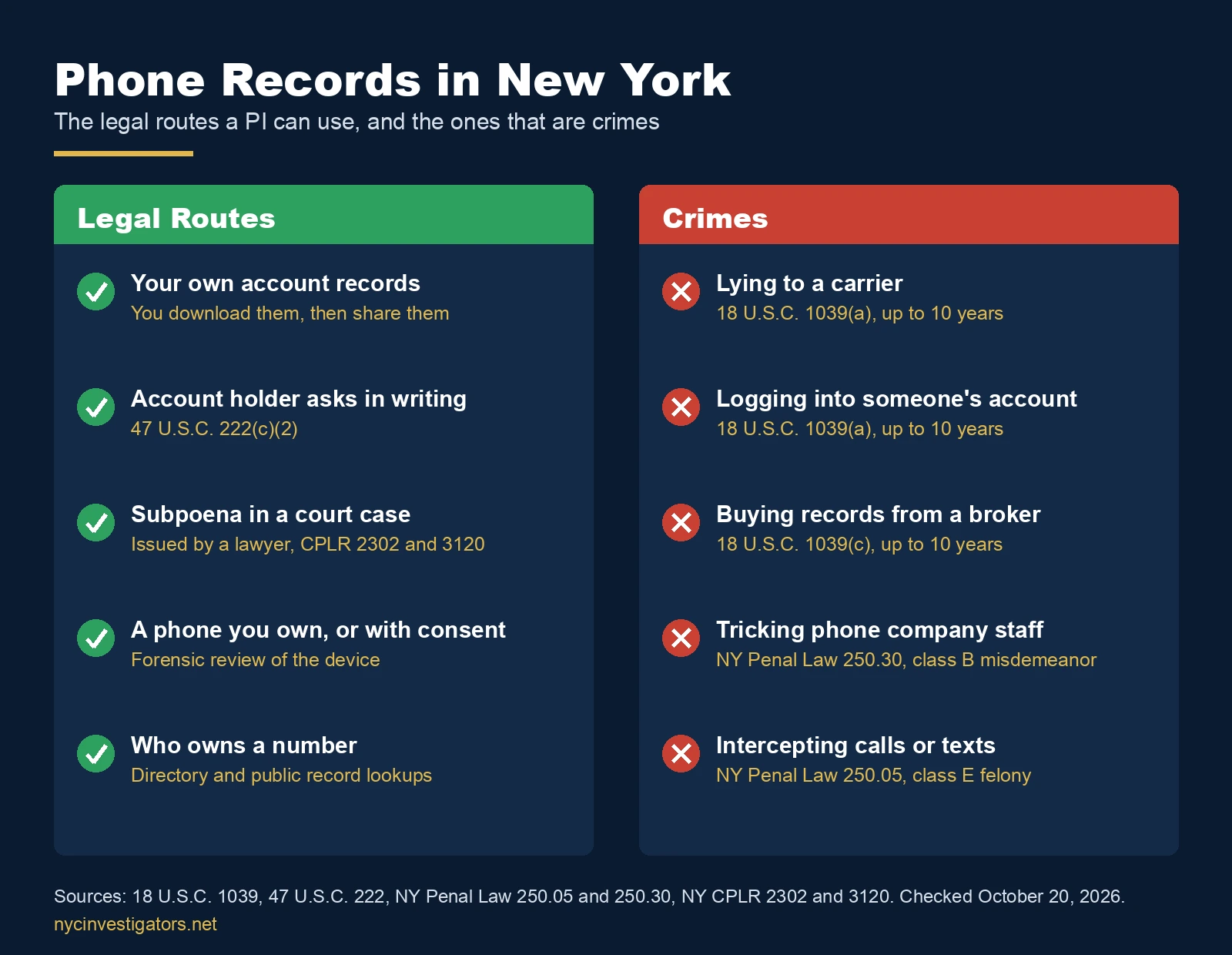
Your Own Records
This is the easy one. You can pull your own call history from your own account and hand it to your investigator. A good PI can then map the numbers, find who owns them and build a timeline. Most real phone work in a PI's office starts here.
A Written Request From the Account Holder
Under 47 U.S.C. 222(c)(2), a carrier must release a customer's call details to anyone the customer names, on the customer's own written request. So if a business owns the account, the business can ask for its records and send them to its investigator or lawyer. The key word is customer. Being on a family plan someone else pays for is not the same as owning the account.
A Subpoena in a Court Case
Once a lawsuit or other case is filed, records can be ordered out. New York's CPLR 2302 lets an attorney of record for a party issue a subpoena without going to a judge first. A PI is not on that list. So the PI can find the facts that justify the request, but the lawyer signs it. The steps are below.
The Phone Itself
A phone you own, or one the owner lets you examine, can be reviewed by a forensic examiner. That is often where call history and messages actually come from. Get the consent in writing. Getting into someone else's phone or messages without it can be eavesdropping under New York Penal Law 250.05, which covers intercepting or accessing an electronic communication. That is a class E felony.
Who Owns a Number
Already have a number and want a name? That is legal research. Section 222 carves out subscriber list information, the name, number and address a carrier publishes in a directory. Investigators also check public records and commercial data tools. This tells you who a number belongs to. It never tells you who that number called.
The Crimes, Federal and New York
Congress passed the Telephone Records and Privacy Protection Act of 2006, Public Law 109-476, approved on January 12, 2007. It created 18 U.S.C. 1039. New York has its own rules on top of it in Penal Law article 250.
| What someone does | The law | Top penalty |
|---|---|---|
| Lies to a carrier or its customer to get call records | 18 U.S.C. 1039(a) | Up to 10 years in federal prison and a fine |
| Hands a carrier a fake document | 18 U.S.C. 1039(a) | Up to 10 years and a fine |
| Logs into a customer's account without permission | 18 U.S.C. 1039(a) | Up to 10 years and a fine |
| Sells or passes on records they know were stolen | 18 U.S.C. 1039(b) | Up to 10 years and a fine |
| Buys or receives those records | 18 U.S.C. 1039(c) | Up to 10 years and a fine |
| Does any of it at scale, over $100,000 or more than 50 customers in 12 months | 18 U.S.C. 1039(d) | Up to 5 more years and a doubled fine |
| Tricks phone company staff for a record of someone's calls | NY Penal Law 250.30 | Class B misdemeanor |
| Gets phone company staff to reveal a call's contents or nature without consent | NY Penal Law 250.25 | Class B misdemeanor |
| Wiretaps, or intercepts or accesses texts and email | NY Penal Law 250.05 | Class E felony |
Read row five again. The buyer is on the hook too. If you pay a PI for a call log you know was pretexted, section 1039(c) reaches you, not just them. The federal law also covers internet phone services. Its definition of a covered carrier includes any provider of IP-enabled voice service.
And New York's Penal Law 250.30 is written almost for this exact scheme. It covers anyone who uses deception or stealth to get a record of any communication passing over a phone company's lines, without the company's authorization. Penal Law 250.25 covers getting phone company staff to reveal a call's contents or nature without consent.
How a Phone Records Subpoena Works in New York

This is the only road to someone else's carrier records in a civil matter. It is slower than people want, and that is the point.
- A case is filedNo case, no subpoena. CPLR 3120 discovery starts after an action begins.
- The PI builds the reasonYour investigator finds the dates, numbers and facts that show why the records matter.
- The lawyer issues the subpoenaUnder CPLR 2302 an attorney of record can sign it. A PI cannot.
- It names the records and the dateCPLR 3120 says the items must be described with reasonable particularity, with at least 20 days to comply.
- Every party gets a copyThe other side is served a copy at the same time, so it can object in court.
- The carrier respondsIt produces the call records the subpoena covers. It does not hand over stored message contents.
Two things to know before you start. First, ask for less. A tight date range and a clear reason are far harder to fight than a request for every call for two years. Second, the other side will see it. Under CPLR 3120(3), the lawyer who issues the subpoena must serve a copy on every other party at the same time. No secret version exists.
What About Text Messages?
This is where most people get a hard no. The federal Stored Communications Act at 18 U.S.C. 2702(a)(1) bars a public communication service from knowingly revealing the contents of messages it stores. The exceptions in 2702(b) include the consent of a sender or recipient and some government routes. A civil subpoena is not one of them.
So in a civil case, lawyers usually go after the phone, not the carrier. They ask the other party to produce messages from its own device in discovery, or they rely on the messages their own client sent and received. A PI can help find what to ask for. A PI cannot pull the texts down from the carrier.
Cell location is the same story. Location of use is part of the protected call details under section 222. Anyone offering to "ping" a phone for you is either bluffing or breaking the law.
When a PI Offers You Phone Records
Walk away. We mean it. The offer usually sounds like one of these, and what each one really means follows.
- "I have a source at the phone company." That is the conduct Penal Law 250.30 describes. A carrier employee who reveals a call's contents or nature without consent commits a misdemeanor too, under Penal Law 250.25.
- "I can get the call log in 48 hours." No lawful route is that fast. A subpoena alone gives the carrier at least 20 days.
- "Just give me their account PIN." Logging in without the customer's permission is the account access crime in 1039(a).
- "Cash only, no contract." A licensed PI who works by the book puts the scope and fee in writing.
Evidence gathered this way can sink your case and expose you as the buyer. If an investigator made this offer, you can report them to the state. Our guide on how to file a complaint against a private investigator in New York walks through it. Before you hire anyone, run their name through the state using our guide on how to check a private investigator license in New York.
The rest of the line between legal and illegal PI work, from records searches to recording calls, is in our guide on what a private investigator can legally do in New York.
What We Hear Most
Can a private investigator get phone records in New York?
Not someone else's from a carrier on their own. Pretexting a carrier or logging into an account is a federal crime under 18 U.S.C. 1039, with up to 10 years in prison. Records come out legally through the account holder or a lawyer's subpoena in a court case.
Can a PI get text messages from the phone company?
No. The Stored Communications Act bars a provider from revealing stored message contents, and a civil subpoena is not one of its exceptions. Texts usually come from the phone itself, with the owner's consent or through discovery in a case.
Can I go to jail for buying someone's phone records?
Yes. 18 U.S.C. 1039(c) covers anyone who buys or receives phone records knowing they were obtained by fraud or without the customer's authorization. The top penalty is 10 years in federal prison and a fine.
Can a private investigator subpoena phone records?
No. In New York, CPLR 2302 lets an attorney of record for a party issue a subpoena, along with court clerks, judges and certain officials. PIs are not on the list. The PI finds the facts and the lawyer issues the subpoena.
Can a PI find out who owns a phone number?
Usually, yes. Directory listings, public records and commercial data tools can tie a number to a name. That is legal. Who the number called is protected call detail and is not part of that search.
How would I know if someone got my phone records?
FCC rules require your carrier to notify you right away when your account password, backup question, online account or address on file is created or changed. An alert you did not expect is a reason to call your carrier and set a new password.
Where These Numbers Come From
- 18 U.S.C. 1039, fraud and related activity in connection with obtaining confidential phone records
- Public Law 109-476, Telephone Records and Privacy Protection Act of 2006
- 47 U.S.C. 222, privacy of customer information
- 47 CFR 64.2010, safeguards on the disclosure of customer information
- 18 U.S.C. 2702, voluntary disclosure of customer communications or records
- NY Penal Law 250.05, 250.25 and 250.30
- NY CPLR 2302 and CPLR 3120
This guide is general information, not legal advice. Sources accessed October 2026. If you need records for a case, talk to a New York lawyer before anyone asks a carrier for anything.